SIP Trunking Services: Complete Guide to SIP Trunks, Pricing, Benefits and Providers
Businesses depend on reliable voice communication to connect with customers, employees, suppliers and partners. As companies move their communication infrastructure to IP-based networks, SIP trunking services have become an important alternative to traditional telephone connections.
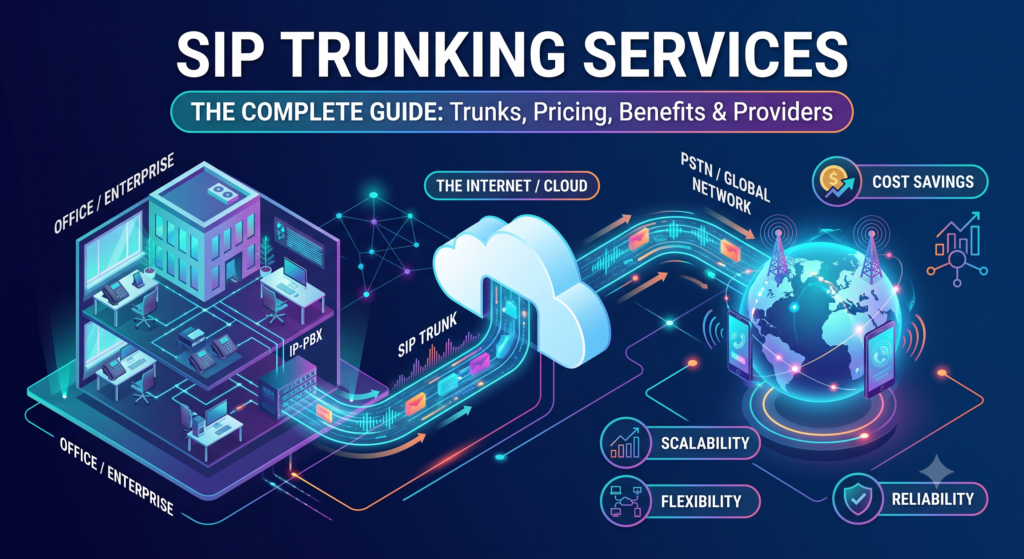
SIP trunking allows businesses to connect an IP-PBX or other IP-based communication system to the public telephone network using Session Initiation Protocol (SIP) over an IP connection. Instead of maintaining traditional physical telephone lines for every connection, businesses can use SIP trunks to manage voice traffic through their existing IP infrastructure.The right SIP trunk provider can help businesses improve flexibility, scale voice capacity, support multiple locations and manage international calling more efficiently.However, choosing a SIP trunking service is not simply about finding the lowest price. Call quality, capacity, geographic coverage, security, redundancy, number portability, technical support and pricing structure all need to be considered.This complete guide explains how SIP trunking works, its benefits, pricing factors, security requirements, common use cases and how to choose the right SIP trunking provider for your business.
What Is SIP Trunking?
SIP trunking is a technology that allows voice communication systems to connect to telephone networks over an IP connection using SIP.The word “trunk” refers to a communication connection that can carry multiple voice channels or sessions.A traditional business telephone system may require multiple physical telephone lines. With SIP trunking, voice traffic can be delivered over an IP network, allowing businesses to manage multiple simultaneous calls through their internet or private network connection.A SIP trunk can connect an organization’s IP-PBX or unified communications platform with a telecommunications provider.This architecture can provide businesses with greater flexibility when adding users, increasing call capacity or connecting multiple offices.Twilio describes SIP trunking as a way to connect IP communications infrastructure to the public switched telephone network (PSTN), supporting both outbound termination and inbound origination.
How Does SIP Trunking Work?
Understanding the basic process makes it easier to evaluate SIP trunking services.A typical SIP trunking setup involves:Business phone system → IP network → SIP trunk provider → PSTN → CustomerWhen a user makes an outbound call, the IP-PBX sends SIP signaling to the SIP trunk provider.The provider determines how the call should be routed and connects it to the appropriate telephone network.
For inbound calls, the process works in the opposite direction.
A customer calls the company’s business number. The call reaches the provider’s network, which uses SIP signaling to deliver the call to the company’s IP-PBX.
Basic SIP trunking components
A typical deployment can include:
- IP-PBX
- SIP trunk
- Internet or private IP connection
- SIP signaling
- RTP media
- Telephone numbers or DIDs
- Voice codecs
- Session border controller
- PSTN connectivity
- Provider routing infrastructure
The exact architecture depends on the provider, business requirements and security model.
What Is a SIP Trunk Provider?
A SIP trunk provider supplies the connectivity and services required to connect an organization’s IP communications system with telephone networks.
Depending on the provider, services may include:
- SIP trunks
- Local numbers
- Toll-free numbers
- International numbers
- Voice termination
- Voice origination
- Call routing
- Number portability
- International calling
- Fraud monitoring
- Technical support
- Call reporting
Some providers focus primarily on business communications, while others specialize in wholesale voice, international termination or carrier services.
The best provider depends on your organization’s traffic profile and technical requirements.
SIP Trunking vs Traditional Phone Lines
SIP trunking uses IP-based connectivity.
This difference can provide several advantages for businesses.
Traditional telephone connections
Businesses may need:
- Physical telephone lines
- Additional hardware
- Separate connections for different services
- Manual capacity expansion
- Local infrastructure
Traditional telephone systems generally rely on dedicated physical connections.
SIP trunking
Businesses can use:
- IP connectivity
- IP-PBX infrastructure
- Centralized voice management
- Flexible call capacity
- Software-based configuration
- Multiple geographic numbers
The appropriate solution depends on the organization’s existing infrastructure, location and communication requirements.
Benefits of SIP Trunking Services
1. Scalability
One of the major advantages of SIP trunking is scalability.Traditional telephone infrastructure can require additional physical connections when call demand increases.With SIP trunking, businesses can often increase capacity through configuration and provider-side changes, subject to available network capacity.
This can be useful for:- Growing companies
- Call centres
- Multi-location businesses
- Seasonal businesses
- Enterprises
- Telecom companies
Before deployment, confirm exactly how quickly the provider can increase concurrent call capacity.
2. Potential Cost Efficiency
SIP trunking can help businesses reduce communication costs by consolidating voice services onto IP infrastructure.
Instead of maintaining separate physical voice connections, companies can use their existing IP network for voice communication where appropriate.However, savings depend on the company’s traffic volume, destinations, infrastructure and provider pricing.
A proper cost comparison should include:
- Monthly trunk charges
- Number charges
- Per-minute rates
- International rates
- Setup charges
- Additional features
- Support
- Network costs
- Redundancy requirements
The cheapest per-minute rate does not always represent the lowest total cost.
3. Geographic Flexibility
SIP-based communications can make it easier for organizations with multiple offices or distributed teams to manage voice services.
A business may be able to centralize its communications infrastructure while supporting users in different locations.
Businesses operating internationally should check the provider’s availability of numbers and services in each target country.
4. Easier Capacity Management
Businesses can manage voice capacity according to expected call demand.
For example, a company operating a contact centre may require significantly more simultaneous calls than a small office.
The number of SIP sessions or concurrent calls required should therefore be estimated before purchasing a service.
5. Business Continuity
SIP trunking can support business continuity strategies when the provider offers appropriate redundancy and routing capabilities.
If a primary connection or route becomes unavailable, traffic can potentially be redirected through another connection or destination.
However, redundancy is not automatic.
Ask your provider about:
- Backup routes
- Secondary SIP trunks
- Multiple points of presence
- Failover
- Geographic redundancy
- Disaster recovery
Cisco documentation describes redundant SIP trunks as a mechanism that can allow signaling to move to a secondary trunk if the primary trunk fails.
6. Support for Multiple Locations
Organizations with offices in multiple cities or countries can use SIP trunking to centralize or simplify their voice infrastructure.
For example, a company may operate offices in:
- Mumbai
- Delhi
- Bengaluru
- Dubai
- London
Rather than treating every office as a completely separate telephone environment, a business can design an integrated IP-based voice architecture.
The actual implementation depends on network connectivity, local regulations, number requirements and provider capabilities.
7. Integration With Business Communications
SIP trunking can work alongside modern business communication systems.
Depending on the environment, businesses can integrate voice services with:
- IP-PBX systems
- Contact centre platforms
- Unified communications
- CRM platforms
- Call recording
- IVR
- Call analytics
- Collaboration tools
This can help businesses create a more connected communication environment.
Who Uses SIP Trunking Services?
SIP trunking is suitable for several types of organizations.
Businesses
Small and medium-sized businesses can use SIP trunks to connect their IP-PBX to telephone networks.
Common requirements include:- Business numbers
- Inbound calling
- Outbound calling
- Call forwarding
- IVR
- Multiple extensions
Enterprises
Large organizations may use SIP trunking across multiple offices.
Enterprise requirements may include:
- High call capacity
- Redundancy
- Centralized management
- International numbers
- Security
- Monitoring
- Multiple SIP trunks
Call Centres
Call centres often generate large volumes of inbound and outbound calls.
They may therefore require:
- High concurrent call capacity
- Multiple routes
- Reliable termination
- Monitoring
- Call analytics
- Failover
- International coverage
Telecom Operators
Telecom operators and communications providers can use SIP connectivity as part of larger voice networks.
Their requirements may include:
- Wholesale voice
- International termination
- Interconnection
- A-Z routes
- High-volume traffic
- Carrier-grade infrastructure
VoIP Providers and Resellers
VoIP companies can use SIP connectivity to deliver voice services to their customers.
They may require flexible pricing, multiple destinations, APIs, route management and scalable capacity.
How Much Does SIP Trunking Cost?
There is no universal SIP trunk price.
The cost depends on the provider, country, traffic volume and service configuration.
A SIP trunk pricing model may include:
Monthly trunk fee
Some providers charge a recurring fee for each SIP trunk.
Per-channel pricing
Pricing may be based on the number of simultaneous calls supported.
Per-minute pricing
Businesses may pay for the actual duration of calls.
Number charges
Local, mobile, toll-free or international numbers may have separate charges.
Setup fees
Some providers may charge an initial setup or provisioning fee.
International termination
International destinations can have different rates depending on the country and network.
Example
Suppose a company makes 200,000 outbound minutes per month.
If the average rate is:
$0.01 per minute
The monthly usage cost would be:
200,000 × $0.01 = $2,000
If the average rate is:
$0.008 per minute
The usage cost would be:
200,000 × $0.008 = $1,600
But this calculation does not include trunk charges, numbers, network costs, taxes or other applicable fees.
Therefore, always compare the total cost of ownership.
What Factors Affect SIP Trunk Pricing?
Several factors can influence pricing.
Destination
Calling destinations have different rates.
Domestic calling may have a different price from international calling.
Fixed vs Mobile
Calls to mobile networks may have different termination costs from calls to fixed networks.
Call Volume
High-volume customers may qualify for customized rates.
Concurrent Calls
The number of simultaneous calls required can affect capacity and pricing.
Billing Increments
Providers may bill calls by different increments.
For example:
- Per second
- 30-second increments
- 60-second increments
Always check the billing method before comparing rates.
Geographic Numbers
Local and international DIDs can have different monthly charges.
Support
Enterprise support and 24/7 technical assistance may be included in premium service packages or priced separately.
How Much SIP Trunk Capacity Do You Need?
Capacity planning is essential.
The number of employees does not necessarily equal the number of simultaneous calls.
For example:
A company may have 200 employees but only 40 employees making calls simultaneously.
Its SIP capacity requirement may therefore be closer to 40 concurrent calls than 200.
At the same time, a call centre with 200 agents may need much higher concurrent capacity.
- Peak call volume
- Average call volume
- Concurrent calls
- Call duration
- Inbound traffic
- Outbound traffic
- Future growth
Twilio’s SIP trunking documentation uses an example bandwidth assumption of approximately 100 kbps per simultaneous G.711 call including overhead. Actual requirements vary by codec, network design and overhead, so businesses should calculate capacity based on their specific deployment.