VoIP Fraud: Common Types, Warning Signs & Prevention Strategies
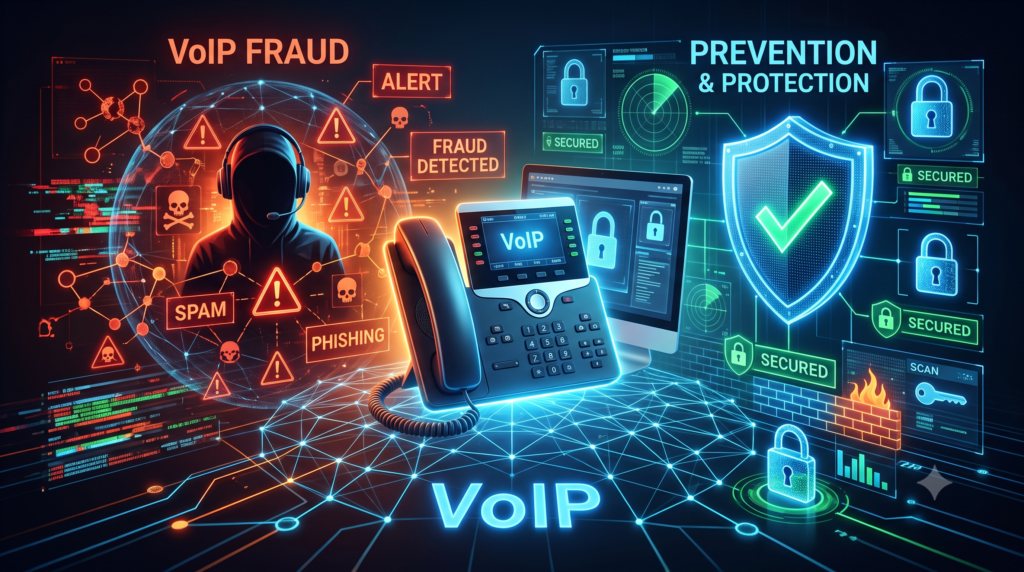
Voice over Internet Protocol (VoIP) has transformed business communications by allowing companies to make and receive calls over IP networks instead of relying entirely on traditional telephone infrastructure. However, because VoIP systems are connected to networks, applications, SIP trunks, endpoints and internet-facing services, they can also become targets for fraud and unauthorized calling.
VoIP fraud occurs when attackers, unauthorized users or compromised accounts misuse a VoIP system to make calls, access communications resources or generate charges without authorization. One of the most damaging forms is toll fraud, where unauthorized calls are placed at the organization’s expense.
Cisco identifies toll fraud as a significant telecommunications security concern and recommends controls such as call restrictions, trusted IP authentication and monitoring to reduce unauthorized calling risks
For businesses using SIP trunks, international termination, wholesale VoIP or cloud communications, fraud prevention should therefore be part of the network and provider-selection strategy—not something addressed only after an unusually large invoice arrives.This guide explains the most common types of VoIP fraud, warning signs, vulnerabilities, prevention strategies and the role of a secure VoIP provider.
What Is VoIP Fraud?
VoIP fraud is the unauthorized or deceptive use of a VoIP communication system to obtain financial or operational benefits.
The attacker may compromise:
- SIP accounts
- VoIP extensions
- PBX systems
- SIP trunks
- Voicemail systems
- Calling applications
- Administrative accounts
- Softphones
- Remote endpoints
- Call-forwarding or transfer features
Once access is obtained, attackers may attempt to make expensive international calls, abuse premium-rate destinations, redirect calls or exploit other voice services.
A common example is toll fraud. An attacker gains access to a compromised extension or VoIP account and uses it to generate large volumes of international calls. The business may initially have no idea that the calls are unauthorized.
Cisco describes toll fraud as calls made at an organization’s expense in violation of its policies and recommends restricting destinations and controlling access to international calling.
Why Is VoIP Fraud a Serious Business Risk?
The financial impact can be immediate.
A compromised account may remain active outside normal business hours, allowing unauthorized calls to continue while employees are offline. Depending on the attack and billing model, the business could face:
- Unexpected international calling charges
- Premium-rate call charges
- Higher telecom bills
- Account suspension
- Disrupted communications
- Loss of customer trust
- Investigation and recovery costs
- Security remediation expenses
For organizations handling significant international traffic, even a short-lived compromise can create substantial exposure.
Common Types of VoIP Fraud
VoIP fraud is not limited to one attack method. Different vulnerabilities can be exploited depending on the organization’s architecture, configuration and security controls.
1. Toll Fraud
Toll fraud is one of the most recognized forms of VoIP fraud.
In a typical scenario, an attacker obtains unauthorized access to a phone extension, SIP account, PBX or other communication resource and uses it to make calls that the organization ultimately pays for.
International destinations are particularly important to monitor because international calling can carry significantly different rates depending on the destination, route and provider.
Attackers may deliberately target systems that permit unrestricted international dialing.
How toll fraud happens
Common pathways include:
- Weak passwords
- Compromised SIP credentials
- Exposed VoIP interfaces
- Misconfigured PBX systems
- Unauthorized remote access
- Compromised voicemail accounts
- Excessive dialing permissions
- Cisco recommends using restriction tables and destination controls to limit unauthorized long-distance and international calling.
2. SIP Credential Compromise
SIP accounts contain authentication information that allows devices or applications to register with a VoIP service.
If SIP credentials are exposed or stolen, attackers may attempt to register unauthorized devices or generate calls using the compromised account.
Weak passwords, reused credentials and poorly protected configuration files can increase the risk.
Businesses should therefore treat SIP credentials as sensitive authentication information rather than ordinary configuration data.
Prevention measures
Organizations can reduce this risk by:
- Using strong unique passwords
- Protecting SIP credentials
- Removing unused accounts
- Restricting registration sources
- Monitoring unusual registrations
- Using provider-supported authentication controls
- Reviewing account activity regularly
Cisco’s current guidance for Unified CME includes IP address trusted authentication to block unauthorized calls from untrusted sources.
3. PBX Hacking
Private Branch Exchange (PBX) systems can become targets when their administrative interfaces, extensions or remote-access mechanisms are inadequately secured.
An attacker who compromises a PBX may attempt to:
- Create unauthorized extensions
- Change call-forwarding rules
- Access voicemail
- Modify dial plans
- Make unauthorized international calls
- Manipulate outbound routes
- Change administrative settings
A compromised PBX can therefore become more than a single-account problem. The attacker may gain access to multiple communication functions.
Regular software updates, restricted administration and strong access controls are essential components of PBX security.
4. Voicemail Fraud
Voicemail systems can also become an attack surface.
If an attacker gains access to a voicemail account, they may potentially exploit call-transfer or notification features depending on the system configuration.
For example, a compromised voicemail account with unrestricted external transfer capabilities could potentially be used to place unauthorized calls.
Cisco specifically recommends configuring restriction tables to control the numbers that voicemail-related functions can access.
How to reduce voicemail fraud
Businesses should:
- Use strong voicemail PINs
- Disable unnecessary external transfer features
- Restrict international destinations
- Remove unused voicemail accounts
- Monitor suspicious transfer activity
Require authentication for remote voicemail access
5. International Calling Fraud
International calling fraud occurs when unauthorized users exploit a VoIP system to generate calls to international destinations.
This is particularly relevant for businesses using:
- International VoIP termination
- Wholesale VoIP
- SIP trunks
- Call centers
- Global business communications
- International DID numbers
A business may normally make international calls, which can make fraudulent activity difficult to identify if there is no baseline for normal traffic.
What makes international fraud difficult to detect?
The organization may already have legitimate international traffic.
Therefore, simply seeing international calls is not necessarily suspicious.
Instead, administrators should monitor changes such as:
- New destinations
- Unusual call volumes
- Calls outside business hours
- Sudden increases in duration
- Unexpected destination countries
- New calling patterns
- Multiple simultaneous calls from one account
6. Caller ID and CLI Abuse
Caller ID, often associated with Calling Line Identification (CLI), is an important part of business voice communications.
Fraudsters may attempt to manipulate caller identification information to disguise the true source of a call or impersonate another number.
For legitimate businesses, CLI management is therefore both a communications and trust issue.
Businesses should work with their VoIP provider to understand how CLI is validated, provisioned and monitored.
7. Call Forwarding Abuse
Call forwarding can be extremely useful for remote workers and business continuity, but poorly controlled forwarding rules can create security risks.
An attacker who gains access to an extension may attempt to forward calls to an external destination.
Depending on the system configuration, this could:
- Increase calling costs
- Redirect business calls
- Expose sensitive communications
- Circumvent normal routing policies
Forwarding rules should therefore be monitored and restricted where appropriate.
8. Robocall and Automated Calling Abuse
VoIP infrastructure can also be misused to generate large numbers of automated calls.
This can create operational and reputational problems, particularly when business numbers are associated with suspicious traffic.
For carriers, wholesalers and service providers, traffic monitoring becomes especially important because abnormal patterns can potentially indicate compromised accounts or misuse of voice infrastructure.
Warning Signs of VoIP Fraud
Early detection is one of the most effective ways to reduce the impact of VoIP fraud.
Businesses should monitor their systems for unusual behavior rather than waiting for billing anomalies.1. Unexpected Increase in Call Volume
A sudden increase in outbound traffic can indicate unauthorized use.
For example, if a business normally makes 500 international calls per day but suddenly generates thousands, administrators should investigate the change.
The key is to compare current traffic against an established baseline.
2. Calls During Unusual Hours
Calls made overnight, during weekends or during public holidays can be a warning sign—particularly when they originate from accounts that normally operate only during business hours.
However, unusual hours alone do not prove fraud.
Global businesses and call centers may legitimately operate around the clock.
The important factor is whether the activity differs significantly from the account’s normal behavior.
3. Unexpected International Destinations
If an account suddenly begins calling countries it has never previously contacted, investigate the activity.
Destination monitoring can be particularly useful for international VoIP users
Businesses can establish approved destination lists and restrict access to countries that are not required for normal operations.
4. Large or Unexpected Telecom Bills
A significantly higher-than-normal telecom invoice is one of the most obvious signs of possible toll fraud.
Don’t wait until the monthly invoice to identify problems.
Real-time or near-real-time usage monitoring can provide earlier visibility.
5. Multiple Registrations From Unexpected Locations
If a SIP account suddenly appears to register from an unfamiliar IP address or geographic location, administrators should investigate.
This can be especially important for remote users and cloud-based environments where legitimate registrations can already occur from multiple locations.
6. Unusual Call Duration
Fraudulent traffic may have different duration patterns from ordinary business calling.
Monitoring
- Average call duration
- Maximum call duration
- Number of simultaneous calls
- Calls per account
- Calls per destination can help identify anomalies.:
How to Prevent VoIP Fraud
A strong VoIP fraud prevention strategy should use multiple layers of security rather than relying on a single control.
1. Use Strong Authentication
Strong authentication is one of the foundations of VoIP security.
Use:
- Strong unique passwords
- Secure administrative credentials
- Individual accounts
- Regular credential rotation where appropriate
- Multi-factor authentication where supported
- Immediate removal of inactive accounts
Never use easily guessed passwords for SIP, PBX or administrative accounts.
2. Restrict International Calling
Not every employee needs international calling access.
Create calling permissions based on business requirements.
For example:
| User Type | Domestic | International | Premium Destinations |
|---|---|---|---|
| General Employee | Yes | Limited | No |
| Sales Team | Yes | Approved countries | No |
| International Team | Yes | Approved regions | Restricted |
| Administrator | Controlled | Controlled | Controlled |
Destination restrictions can substantially reduce the potential impact of compromised accounts.
Cisco recommends configuring restriction tables to block unnecessary international destinations and prevent users from bypassing restrictions through trunk access codes
3. Use Trusted IP and Network Controls
If your VoIP architecture allows it, restrict communication to known and authorized sources.
Cisco’s Unified CME documentation describes IP address trusted authentication as a mechanism for validating incoming VoIP traffic against a trusted IP list and rejecting calls from untrusted sources.
Organizations should also consider:
- Firewalls
- Network segmentation
- Access control lists
- VPNs for remote connections
- Secure management interfaces
These controls should be designed according to the specific VoIP architecture.
4. Secure SIP Trunks
SIP trunks should not be treated as simple internet connections.
Businesses should understand:
- Who can send traffic to the trunk
- Which IP addresses are trusted
- Which destinations can be called
- How authentication works
- How traffic is monitored
- What fraud controls the provider offers
- What happens when abnormal traffic is detected
A secure SIP trunk configuration should align with the organization’s overall network security policy.
5. Monitor Call Detail Records
Call Detail Records (CDRs) provide valuable information about voice activity.
Depending on the system and provider, CDRs can include information such as:
- Calling number
- Called number
- Call start time
- Call duration
- Call status
- Destination
- Route
- Account or extension
Analyzing this data can help identify abnormal calling patterns.
Cisco recommends call activity monitoring and call-history logging as part of toll-fraud prevention and investigation.
6. Set Usage Alerts
Businesses should establish thresholds for unusual activity.
Examples include alerts for:
- Sudden call-volume increases
- High international usage
- New destination countries
- Excessive concurrent calls
- Calls outside defined hours
- Unexpected account registrations
- Rapid increases in telecom spending
The objective is simple:
Detect abnormal behavior before it becomes an expensive incident.
7. Disable Unused Features
Every unnecessary feature can increase the potential attack surface.
Review whether your organization actually needs:
- External call forwarding
- International dialing
- Remote administration
- Unused extensions
- Old SIP accounts
- Legacy gateways
- Unused voicemail features
If a feature isn’t required, consider disabling it.
8. Keep VoIP Systems Updated
VoIP infrastructure includes software, PBXs, SBCs, gateways, routers, phones and applications.
Security vulnerabilities can emerge over time.
Cisco recommends regular software updates as part of VoIP security practices.
Businesses should establish a patch-management process and ensure that supported systems remain updated.
9. Protect SIP Signaling and Voice Media
VoIP security isn’t only about preventing unauthorized calls.
Businesses may also need to protect signaling and voice media from unauthorized access.
Depending on the architecture and provider capabilities, organizations can evaluate technologies such as:
- SIP over TLS
- Secure Real-time Transport Protocol (SRTP)
- VPN connections
- Firewalls
- Secure SBC deployments
Cisco recommends encryption of sensitive voice traffic and identifies SIP TLS and SRTP as technologies that can protect signaling and media.
10. Choose a VoIP Provider With Fraud Controls
Your provider plays an important role in VoIP security.
Before selecting a VoIP service provider, ask:
- Do you provide real-time usage monitoring?
- Can international destinations be restricted?
- Do you provide fraud alerts?
- Can suspicious traffic be automatically blocked?
- How are SIP credentials protected?
- Do you support IP authentication?
- What security controls exist at the network level?
- How quickly can compromised accounts be suspended?
- Can spending or traffic thresholds be configured?
- How are abnormal call patterns investigated?
A provider should be able to explain its fraud-management process clearly.
VoIP Fraud Prevention Checklist
Use this checklist when auditing your VoIP environment:
Account Security
- Use strong credentials
- Remove inactive accounts
- Protect SIP credentials
- Limit administrative access
- Use MFA where supported
Calling Controls
- Restrict international destinations
- Block unnecessary premium-rate destinations
- Limit external forwarding
- Apply role-based dialing permissions
Network Security
- Use firewalls
- Restrict trusted IP addresses
- Segment voice networks where appropriate
- Secure remote connections
- Protect management interfaces
Monitoring
- Review CDRs
- Monitor international traffic
- Set usage alerts
- Monitor registrations
Provider Management
- Understand fraud controls
- Review rate and usage reports
- Establish escalation procedures
- Ask about automatic fraud detection
- Confirm emergency account suspension procedures
Track unusual call volume
VoIP Fraud vs VoIP Security: What's the Difference?
These terms are related but not identical.
VoIP security is the broader discipline of protecting voice systems, users, networks and communications.
VoIP fraud specifically concerns unauthorized or deceptive use that creates financial, operational or other losses.
For example:
- SIP credential theft can be a security incident.
- Using those stolen credentials to make expensive calls can become VoIP fraud.
- Eavesdropping is a security and privacy issue.
- Manipulating calling services to generate unauthorized charges is fraud.
A comprehensive security strategy should address both.
How Wholesale VoIP Providers Can Reduce Fraud Risk
Fraud prevention becomes even more important for wholesale VoIP providers, carriers and telecom operators because they may handle large volumes of international voice traffic.
Wholesale environments should consider:
- Customer authentication
- IP whitelisting
- Destination controls
- Traffic profiling
- Real-time monitoring
- CDR analysis
- Rate-limit controls
- Account-level thresholds
- Automated alerts
- Route monitoring
- Suspicious traffic investigation
Because legitimate wholesale traffic can be high-volume, providers need intelligent monitoring rather than simply blocking large call volumes.
The objective is to identify abnormal behavior relative to a customer’s normal traffic profile.
The Role of LCR in VoIP Fraud Management
Least Cost Routing (LCR) is primarily designed to select cost-efficient routes for calls.
However, routing policies should not focus exclusively on price.
A route with a lower nominal rate may not necessarily be the best choice if it introduces quality, reliability, compliance or fraud-management concerns.
Businesses and carriers should evaluate routing using multiple factors, including:
- Cost
- Quality
- Destination
- Route reliability
- ASR
- ACD
- PDD
- Fraud risk
- Provider reputation
A strong routing strategy balances cost optimization with quality and security.
What Should You Do If You Suspect VoIP Fraud?
If you identify suspicious calling activity, act quickly.
Step 1: Identify the affected account
Determine which extension, SIP account, trunk or system generated the suspicious traffic.
Step 2: Stop unauthorized activity
Depending on the circumstances, temporarily disable the affected account or outbound calling permissions.
Step 3: Contact your provider
Ask the provider to investigate the traffic and suspend suspicious activity if necessary.
Step 4: Change credentials
Reset affected passwords and review other credentials that may have been exposed.
Step 5: Review logs
Analyze CDRs, registration logs, authentication records and system logs.
Step 6: Identify the entry point
Determine whether the incident involved:
- Stolen credentials
- Misconfiguration
- Compromised endpoint
- Exposed PBX
- Unauthorized remote access
- Weak administrative security
Step 7: Strengthen controls
After resolving the incident, update restrictions, authentication, monitoring and access policies.
How to Choose a VoIP Provider With Strong Fraud Protection
Fraud prevention should be part of the provider-selection process.
When comparing providers, don’t evaluate only:
Price per minute.
Also evaluate:
Security
Does the provider offer authentication, IP restrictions and security controls?
Monitoring
Can you see your traffic and identify unusual usage?
Fraud alerts
Will the provider notify you when unusual activity occurs?
Destination controls
Can you restrict countries or number ranges?
Support
Can the provider respond quickly when suspicious traffic occurs?
Scalability
Can security controls continue to work as your traffic increases?
Routing transparency
Can you understand how your calls are routed and what affects your rates?
For organizations handling international voice traffic, these factors can be as important as the advertised per-minute rate.
Frequently Asked Questions About VoIP Fraud
What is VoIP fraud?
VoIP fraud is the unauthorized or deceptive use of VoIP services, accounts or infrastructure. It can include toll fraud, unauthorized international calls, compromised SIP accounts, PBX abuse and call-forwarding misuse.
What is toll fraud in VoIP?
Toll fraud occurs when unauthorized users make chargeable calls through an organization’s telecommunications system, causing the organization to pay the resulting charges. Cisco identifies toll fraud as a telecommunications security concern and recommends call restrictions and other controls.
How does VoIP fraud happen?
Common causes include weak credentials, compromised SIP accounts, exposed VoIP systems, poorly configured PBXs, excessive international dialing permissions and insufficient monitoring.
How can businesses prevent VoIP fraud?
Businesses should use strong authentication, restrict international calling, secure SIP trunks, monitor CDRs, establish usage alerts, protect remote access, keep systems updated and work with providers that offer fraud-management controls.
Can SIP trunks be hacked?
SIP infrastructure can be targeted if authentication, network access and other security controls are poorly configured. Businesses should use appropriate access restrictions, authentication and network security measures.
How can I detect VoIP fraud?
Look for unusual call volume, unexpected international destinations, calls outside normal business hours, suspicious registrations, abnormal call duration and unexpected increases in telecom spending.
Is VoIP more vulnerable to fraud than traditional phone systems?
The security risks are different. VoIP uses IP networks and software-based systems, creating additional network and authentication considerations. At the same time, VoIP can provide detailed monitoring, access controls and automated security mechanisms when properly configured.
Does a VoIP provider prevent all fraud?
No provider can guarantee that every form of fraud will be prevented. Businesses should combine provider-level controls with secure configurations, strong authentication, monitoring and internal security policies.
Final Thoughts: Build VoIP Security Before Fraud Happens
VoIP provides businesses with flexibility, scalability and access to domestic and international communications. But the same connectivity that makes VoIP powerful also makes security and fraud prevention important.
VoIP fraud prevention should be approached as a layered process.
Start with strong authentication. Restrict unnecessary international calling. Secure SIP accounts and trunks. Monitor call activity. Review CDRs. Establish alerts. Keep systems updated. Most importantly, choose a VoIP provider that can support your security and monitoring requirements.
For businesses using international calling, SIP trunking, wholesale voice or VoIP termination, fraud prevention should be considered part of the overall communications strategy—not an afterthought.
A secure VoIP environment is not simply about preventing an unexpectedly high telecom bill. It is about protecting communication infrastructure, controlling access, maintaining service reliability and ensuring that voice traffic remains under the organization’s control.
If your business is evaluating VoIP services, SIP trunking, international voice termination or wholesale VoIP, evaluate security and fraud-management capabilities alongside pricing, route quality and coverage.
Talk to iGlobe Telecom about your business VoIP requirements and explore voice solutions designed around reliability, routing, scalability and security.