Best VoIP Routes for International Calling: Quality vs Cost
A VoIP route is the network path a call takes from an originator’s switch or PBX to the destination’s carrier network. For outgoing (termination) calls, your traffic is sent either directly to the destination’s carrier (best quality, fewer hops) or routed via one or more intermediaries (wholesale carriers or resellers). In practice, 71% of international voice traffic in 2024 was terminated by wholesale carriers. Each path (“route”) can differ in cost, quality, and compliance features (like caller-ID preservation). Good routes minimize hops, delays and transcription, while cheap routes often drop quality.

- Direct (Carrier‑Direct) Routes: Your provider has interconnects directly with the destination operator. These involve fewest hops and highest accountability. Expect better ASR, lower PDD and full CLI (caller ID) integrity.
- Indirect/Wholesale Routes: Your call is handed to a wholesale carrier or brokered through others before reaching the destination. More hops generally mean higher latency, jitter and risk of dropped calls. These often offer lower headline rates but can degrade quality.
- Grey Routes: Illegitimate paths that avoid licensing or authorized interconnects (often misrepresenting CLI). They are very cheap but risky – unreliable and non‑compliant. Avoid these for serious business use.
International VoIP Traffic: Wholesale carriers terminated ~217 billion minutes in 2024, slightly down from 2023. They carry over 2/3 of all international voice calls. The global wholesale voice market was ~$40.3B in 2025 and is projected to reach $73.6B by 2031 (≈10.6% CAGR). These shifts reflect declining traditional voice but growing VoIP traffic. The U.S., Europe and Asia are major markets, with Asia-Pacific seeing the fastest growth. This large market means many route choices: from premium Tier-1 paths to budget options.
Best VoIP Routes for International Calling: Quality vs Cost Facebook X-twitter Youtube Best VoIP Routes for International Calling: Quality vs […]
VoIP Fraud: Common Types, Warning Signs & Prevention Strategies Voice over Internet Protocol (VoIP) has transformed business communications by allowing […]
VoIP Termination: Complete Guide to International Voice Routes, Pricing and Quality Facebook X-twitter Youtube International voice communication depends on reliable […]
Route Types: Direct, Indirect, Premium, Standard, A–Z, CLI/Non-CLI
How VoIP Routing Works: LCR and Quality-Based Routing
Direct vs Indirect Routes
Direct routes connect your network straight to the destination’s licensed carrier. This minimizes hop count, reducing delay and potential failures. Indirect or wholesale routes hand off calls through one or more intermediary carriers, which may each apply their own LCR logic. Each additional hop introduces delay (PDD), jitter and MOS degradation. For example, calls on direct Tier-1 links often have lower post-dial delay (PDD) and higher answer rates than calls re‑routed through multiple vendors.
Premium vs Standard Routes
“Premium” routes are engineered for highest quality and full CLI preservation. They typically use direct or minimal-hop paths and Tier-1 interconnects. Premium routes often guarantee high ASR (60–80%+ target) and low PDD (under 6 s). These yield better user experience and compliance (e.g. STIR/SHAKEN A-level) but cost more. Standard routes lower cost by accepting some compromises (e.g. no CLI or longer paths).
For high-value uses (sales, support, contact centers), premium routes justify higher cost with consistent answer rates and voice clarity. For bulk traffic (e.g. notifications or anonymous dialers), standard/non-CLI routes save money.
A–Z Route Decks
“A–Z” decks are international termination rate cards covering all countries (A through Z). They offer broad coverage but vary by destination quality. A provider’s A–Z deck should list per-minute rates for each country. Beware decks that omit major destinations or hide quality details. Always request ASR/ACD benchmarks per country.
CLI, Non‑CLI and CC Routes
Wholesale carriers often offer three route categories (see table below) based on CLI (caller ID) handling:
CLI routes preserve the caller’s number end‑to‑end. Non-CLI routes replace or strip the ID, which can give lower pricing at the cost of recognizability and higher fraud risk. CC routes show only the country code (e.g. “+91”) – cheaper than CLI but better acceptance than blank. High-quality wholesale providers share which routes exist and the ASR/PDD targets for each.
| Route | Per-min Rate | ASR (%) | ACD (min) | PDD (s) | Latency (ms) | Effective Cost* |
|---|---|---|---|---|---|---|
| A: Direct CLI (Tier-1) | $0.008 | 95 | 5.2 | 2.5 | 120 | $0.00842 |
| B: Brokered CLI | $0.006 | 70 | 4.0 | 4.8 | 200 | $0.00857 |
| C: Direct CC | $0.005 | 80 | 3.5 | 3.0 | 150 | $0.00625 |
| D: Brokered Non-CLI | $0.003 | 50 | 2.8 | 6.5 | 250 | $0.00600 |
Least-Cost Routing (LCR)
LCR is an automated decision engine that selects the cheapest available route for each call, subject to quality constraints. Modern LCR uses dynamic criteria: it monitors real-time quality data (ASR, PDD, MOS) and fails over if a route degrades. For example, with AI-driven LCR, some carriers report 30–50% cost savings while maintaining quality benchmarks. LCR must balance price vs performance – a route with a low nominal rate but very low ASR can end up costing more per answered call.
Quality‑Based Routing
Quality-based routing means embedding service-level thresholds into route selection. Instead of strictly cheapest, the system ranks routes by a composite score (cost + metrics). For instance, a route is only considered “available” if ASR ≥ 60% and PDD ≤ 6s. Fig. below illustrates a routing decision flowchart:
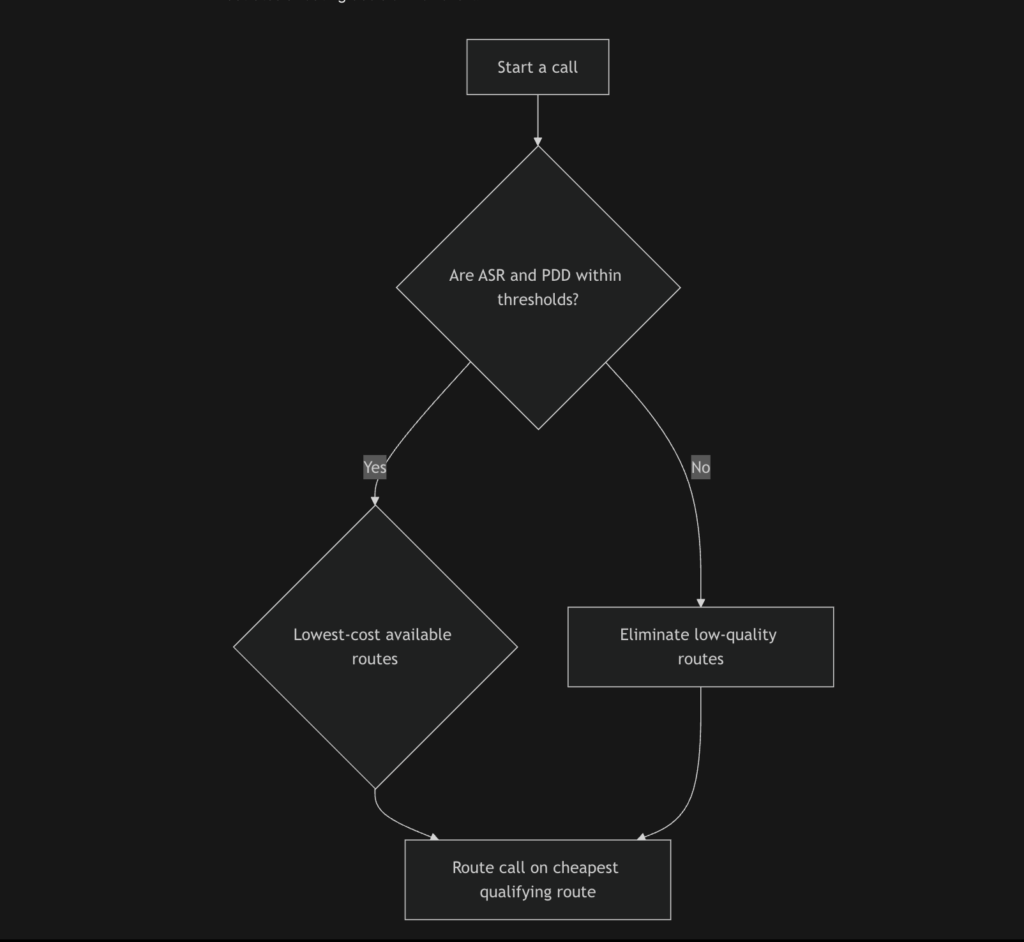
This ensures cheap routes are used only if quality is acceptable. Combining LCR with quality checks means high-quality calls (e.g. emergency or VIP customers) always use better routes, while mass non-critical traffic is dialed at rock-bottom prices.
VoIP Routing Cost Drivers
Several factors determine the per-minute cost of an international VoIP route. Understand these to forecast spend and compare offers:
- Destination (Country & Network): A mobile number in a high-fee country costs much more than a local landline. For example, US landlines may cost $0.006–$0.012/min, whereas Indian or Nigerian mobile might be $0.01–$0.04/min.
- Route Quality: Routes with higher ASR and MOS carry a premium. A route costing $0.005/min with 60% ASR can cost more per effective minute than a $0.008/min route with 95% ASR.
- Fixed vs Mobile: Mobile termination (especially in developing markets) usually has higher termination fees.
- Route Type (CLI vs Non-CLI vs CC): Non-CLI and CC routes are cheaper (often 20–40% less than CLI), but bill the user’s number differently.
- Traffic Volume: Higher volume commitments unlock lower unit rates. Vendors often negotiate deals starting at tens of thousands of minutes per month.
- Billing Increments: How calls are rounded (e.g. 6/6s vs 60/60s) affects cost on short calls. A 20s call billed as 60s (60/60) effectively triples its cost. Using 6/6 or 1/1 increments is cheaper for bursts of brief calls.
- CLI/Branding Premiums: Compliant routes with STIR/SHAKEN attestation often have a small markup, justified by higher answer rates in regulation-heavy markets.
- Minimum Commitment & Contract: Contract terms (minimum minutes per month, overage policies) can alter effective price. Committed-volume pricing may lower per-minute rate but requires a fixed volume.
In practice, the “nameplate” rate on a price sheet rarely equals the true cost. One study found effective cost is shaped by ASR, PDD, False Answer Supervision (FAS) and destination mix, not just the headline rate. Wholesalers should model a route’s effective cost: for example, adjust the nominal rate by (1/ASR) to see cost per answered minute.
Cost vs Quality – Data Examples
Consider two routes to the same destination:
Route A: $0.005/min, ASR = 60%, ACD = 3 min, PDD = 8s.
Route B: $0.008/min, ASR = 90%, ACD = 5 min, PDD = 3s.
Nominal price: A is cheaper per minute.
Effective cost per completed call (ignoring ACD): A costs $0.005/0.60 = $0.00833 per answered minute. B costs $0.008/0.90 = $0.00889.
Thus A saves only ~6% (instead of 37.5% on raw rate) but delivers far fewer answered calls and longer delays (dead air) for callers. In volume, A’s failed 40% attempts still consume network resources.
Example Calculation: If you send 10,000 call attempts in an hour:
On Route A (60% ASR): 6,000 answers → ~$50 cost.
On Route B (90% ASR): 9,000 answers → ~$72 cost.
Cost per answered call: A = $50/6k = $0.00833; B = $72/9k = $0.00800 (similar). But 3,000 callers on A heard silence or failure.
This illustrates why ASR is a key cost driver: a higher ASR route may be worth its higher rate. Many carriers bill on connected time, so FAS (False Answer Supervision) fraud (being billed for unanswered calls) should be avoided.
Quality Metrics That Define a Good Route
Table: Route Comparison (Country Y)
| Route | Per-min Rate | ASR (%) | ACD (min) | PDD (s) | Latency (ms) | Effective Cost* |
|---|---|---|---|---|---|---|
| A: Direct CLI (Tier-1) | $0.008 | 95 | 5.2 | 2.5 | 120 | $0.00842 |
| B: Brokered CLI | $0.006 | 70 | 4.0 | 4.8 | 200 | $0.00857 |
| C: Direct CC | $0.005 | 80 | 3.5 | 3.0 | 150 | $0.00625 |
| D: Brokered Non-CLI | $0.003 | 50 | 2.8 | 6.5 | 250 | $0.00600 |
*Effective cost = rate/ASR (cost per answer-minute). Data are illustrative.
This table highlights trade-offs: Route A has the best ASR/ACD and lowest PDD but higher nominal rate. Route D is cheapest but only half calls complete. Routes B/C show mixed profiles. In practice you’d choose A for critical calls, D for bulk notifications, etc.
Route quality is judged by objective metrics. Key ones include:
- ASR (Answer-Seizure Ratio): % of call attempts that complete (get an answer). Formula: ASR = (answered calls ÷ attempted calls)×100. Benchmarks: ≥40–50% is acceptable; ≥60%+ is excellent. Wholesale providers often target 95%+ ASR on premium routes. Low ASR could mean network failures or many unanswered calls.
- ACD (Average Call Duration): Average length of answered calls. Longer ACD (>4–5 min) generally indicates more engagement and less dropped calls. Very low ACD (<2 min) can signal poor quality or many short failed sessions.
- PDD (Post-Dial Delay): Time from dialing to hearing a ringback. Twilio defines PDD as delay from SIP INVITE to 180/183 response. Ideally under 3–4 seconds. Extended PDD (>6s) feels like dead air and indicates routing delays.
- Latency: One-way delay ideally <150ms (ITU-T G.114 standard). >150ms causes talking interruptions; >300ms causes echo and talk-over issues.
- Jitter: Variation in packet arrival times. Best kept under ~30ms. More than 30ms jitter causes choppy audio.
- Packet Loss: Ideally <1%. Loss causes gaps in speech. Even small bursts of loss degrade quality.
- MOS (Mean Opinion Score): A subjective score (1–5) of perceived audio quality. 4.0+ is “toll quality”. Below 3.5 is noticeably poor.
- FAS (False Answer Supervision): Calls billed as answered when they were not. FAS-free billing (charged only for real answered time) is a must-have to avoid fraudulent charges.
Regularly monitoring these metrics per route is essential. Many wholesalers provide real-time dashboards for ASR, PDD, etc. Aim for target benchmarks (ASR 60–80%+, PDD <4s, MOS >4) as indicators of premium routes.
Implementation Checklist
- Define traffic profile: Identify major destinations and expected call volume per.
- Gather rate decks: Request A–Z pricing and route options from multiple providers.
- Shortlist providers: Based on coverage, announced rates, and published metrics.
- Plan trials: Prepare test numbers in key countries.
- Run trial calls: Measure ASR/PDD/ACD for each route candidate.
- Analyze results: Compare metrics and compute effective costs (rate÷ASR).
- Negotiate & commit: Choose routes by business need (quality vs cost) and negotiate volume discounts or contracts with necessary SLAs.
- Configure routing: Implement via your SBC/LCR engine, with failover logic.
- Monitor continuously: Set up CDR collection, dashboards and alerts.
- Review regularly: Re-test periodically and update contracts as traffic shifts or new routes emerge.
Following this plan ensures you implement the “best VoIP routes” systematically, matching technical performance with commercial objectives.
Frequently Asked Questions
Q1: What are the different types of international VoIP routes?
A: Routes differ by connection path and ID handling. Direct CLI routes are end‑to‑end (few hops) with caller ID preserved. Brokered/indirect routes pass through one or more intermediaries (more hops). Premium (Tier-1) vs standard routes denote quality levels. Non-CLI routes strip the number (cheaper). Country-Code (CC) routes show only +country. Each type has trade-offs in cost and call success.
Q2: How does Least-Cost Routing (LCR) optimize calls?
A: LCR automatically selects the cheapest available route for each call, re-evaluating as rate decks and quality change. Modern LCR uses real-time ASR/PDD data: if a low-cost route degrades, LCR “fails over” to the next-best route to avoid dropped calls. This balances cost with service quality.
Q3: Why is ASR important for route quality?
A: ASR (Answer-Seizure Ratio) measures how many dialed calls actually connect. A low ASR means many attempts fail (busy, no answer, network fault). Routes with higher ASR (>60%) deliver more connected calls. A cheap route with very low ASR can cost more per answered minute than a pricier route with high ASR. Thus ASR is a key indicator of reliability and cost-effectiveness.
Q4: What factors most influence international VoIP call costs?
A: The main cost drivers are destination network type (mobile vs fixed and country termination fees), route quality (ASR/PDD), volume commitments, and billing increments. CLI vs non-CLI routes also differ in price. Regulatory fees and exchange rates can also affect costs. Always compare effective cost per answered minute, not just raw rates.
Q5: How can I prevent fraud on VoIP routes?
A: Use strong account security (unique SIP credentials, IP restrictions), restrict unnecessary international dialing, and monitor call patterns. Work with providers that offer fraud controls (FAS-free billing, real-time alerts, rate limiting). Validate CLI and use STIR/SHAKEN to deter spoofing. Quickly disable any extension or trunk showing anomalous traffic. Regular audits and anomaly detection (ASR spikes, unusual destinations) help catch fraud early.
Conclusion
Choosing the best VoIP routes for international calling requires a holistic view: cost, quality, and trust all matter. Use robust quality metrics (ASR, ACD, PDD, MOS, etc.) to compare routes, not just headline rates. Invest in premium Tier-1 routes for critical traffic and use cost-efficient routes for bulk calls. Implement dynamic LCR with quality thresholds to adapt in real time. Rigorously test every route with live traffic before committing volume.
VoIP can be a reliable, high-margin service when voice traffic is managed correctly. As industry analysis notes, a disciplined operator that matches route type to traffic profile and demands quality data can make voice one of the most predictable revenue sources. In the end, the cheapest route on paper isn’t always the best in practice – it’s the well-measured, high-confidence route that delivers value.
Contact us: Talk to iGlobe Telecom about optimizing your international voice routes. Our wholesale VoIP termination offers transparent quality metrics, 24/7 monitoring and custom pricing. Get a free test quote today!
Sources
- TeleGeography, “How Do Wholesale Carriers Fit In the Global Traffic Picture?” (Oct 2025)
- Twilio Docs, “What is Post-Dial Delay?” (2026)
- Cisco IOS XE, “Voice Quality on IP Networks”
- Kolmisoft VoIP Blog, “ASR and ACD” (Oct 2015)
- Softtop Tech, “VoIP Wholesale Termination: How It Works” (Jun 2026)
- Ajoxi Blog, “Wholesale VoIP Rates 2026” (Japanese site)
- SIPNEX Blog, “VoIP Routes: Origination, Termination, Quality”
- Flowroute Blog, “How Wholesale VoIP Pricing Works” (Sep 2026)
- Mordor Intelligence, Wholesale Voice Carrier Market Report 2026-31
- Nextiva Blog, “How Network Jitter Affects VoIP”